To even the most naive visitor, Belfast is clearly a city that has seen rough times - there are many empty buildings, abandoned lots, razor wire fences and bars over windows. But it is also clearly a city that is coming back to life - tourism has made huge changes throughout the area, and while there is still tension, change is in the air.
We took a "Black Cab" tour - it was an excellent way to see the divisions that still define Belfast and have a very personalize account of what happened. It's a cab service, really, except that the drive takes you around to the various neighborhoods of Belfast, explains the conflict, and talks about how things have changed and what is still changing. It was very poignant. So it was just me and Michael and this cabby, a local guy who grew up during the height of the Troubles, driving around the "Peace Walls" - giant, military looking walls with spikes and huge gates that lock every night (still, today) that separate the Protestants from the Catholics. He did a very good job staying fairly neutral and explaining the elements of each side, although it was clearly still a very personal experience for him.
For a bit of back ground, which is the only way to even try to make sense of the conflict - it really dates back to the Elizabethan era, when Queen Elizabeth the first was worried that Catholic Spain would be able to attack mainland Britain through Catholic Ireland, and started what's known as "Plantation" (such good connotations that word has...), and granted British Protestants rights to evict the native Catholic Irish and found a community loyal to the English Crown. Naturally, that didn't sit very well with the Irish people, and began a centuries long pattern of abuse by the English (according to some). Then, in the 1690s, the king of England converted to Catholism - not ok by most English Folk, and that sparked an insurrection led by Prince William of Orange, who defeated King James II at the Battle of Boyne in Northern Ireland on the 12th of July. That date is commemorated every year by Protestants as a great victory for the Irish Protestants and the English Crown. Fast forward through the 1700 and 1800s (and the Great Famine and all that jazz) and we get to the early 1900s, when the British Empire has mostly given up its colonies and is more open to the concept of self-rule. Irish people thought that was a good idea, and started campaigning for Home Rule. Except that the Protestants living in Northern Ireland considered themselves entirely British - they (still) don't consider themselves Irish at all - and firmly opposed home rule. They were concerned (ironically, we'll see), that Home Rule would produce a Catholic government out of Dublin and they, as the religious and loyalist minority, would be persecuted. As a compromise after WWI, Northern Ireland was created, as a protestant country for protestant people with a protestant government that was loyal to the British Crown, while the rest of Ireland formed its own republic. That was all well and good, except for the Catholics who still lived in Northern Ireland. And here's where the irony kicks in - so afraid were the Protestants about being persecuted that they created a system that completely relegated Catholics to second class citizenry. Gerrymandering voting districts, disenfranchising catholic voters who weren't home owners, discriminating in the work place... you name it. After decades, Catholics were fed up, and finally, in 1969, things exploded. Literally. The British military was called in to keep the peace, which was seen by some as a occupying force, and years of conflict commenced. It took until the 1990s to finally find compromises that brokered some peace (Northern Irelanders love Bill Clinton for it, as he played a large role in negotiating that peace), and Belfast began a long, slow healing process.
The most shocking thing, as an outsider who wasn't born yet to watch the news as it happened, is how still very active the division is. There isn't much violence anymore, but the walls separating Catholics and Protestants still stand, and are unlikely to come down anytime soon due to continued mistrust and prejudice. But at the same time, every Belfast person we've talked to has characterized it as "madness" and are invested in the peace process - but it is a process, and it's really only been 10-15 years since there has been any real compromise.
The tour took us through one of the most Protestant neighborhoods and one of the most Catholic neighborhoods, and it was very clear that not everyone is ready to forgive and forget centuries of anamosity quite yet. On the Protestant side of the fence, there are signs in windows that say "Proud to be British" and a million and one Union Jacks (this is heightened because the 12th of July is coming up and Protestants are getting ready to celebrate - they also celebrate with building sized bon fires. Seriously building sized, assembled out of pallets. We saw some little kids helping set one up - the base took up most of an empty lot. The fires are just huge beacons, and I'm amazed that they don't light the whole city on fire. And there are dozens of them all throughout Protestant Belfast, and the rest of Northern Ireland. I don't think it's quite as provocative now, but I could totally see this as a massive, yearly equivalent to burning crosses on African-American's lawns. And little kids are still helping set these up!). On the other side of the fence, you see the Green, White and Orange flag of the Irish Republic. There are huge murals and memorials to guerilla fighters on each side - on one side, a person is memorialized as a hero, and on the other, that same person is condemned as a terrorist and a murderer. And it absolutely goes both ways. Like, there are still paintings up supporting the UVF (Ulster Volunteer Force) and the UDV (Ulster Defence Volunteers) in the Protestant neighborhoods, and the IRA and the resistance fighters in the Catholic neighborhoods.
The houses directly next to the 'Peach Walls' (and yes, there are residential houses butting right up to each side of the fence - talk about not knowing your neighbors) have cages over the back windows to protect against things being thrown. Our guide pointed out where some of the houses took their guards down just last summer.
I don't have many pictures from today - it felt somewhat disrespectful and insensitive to take too many, especially of the memoriam ones.
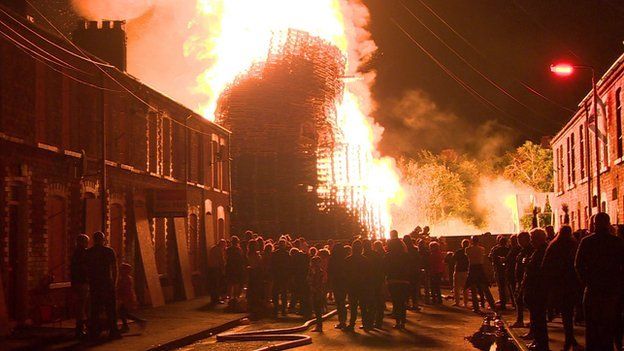 |
| Picture from the internet of the bon fires. We saw one that will reach an equivalent size being built, so this still happens every year. |
 | |
| Another picture from the internet of the 12th of July Bon Fire celebrations in Belfast... you can see how crazy the fires are. |
 |
| One of the murals in the Protestant neighborhood we drove through. This is another picture from the internet, because it just felt weird to take photos of this stuff. In this neighborhood, this man is commemorated as a celebrated hero. Across the street and on the other side of the wall, he is remembered as one of the most ruthless murders, who killed innocent people in cold blood, who were just trying to go about their lives during the conflict but got in the way. |
 |
| One of the Catholic side murals, commemorating "martyrs" from the IRA - this is another internet picture from apparently a while ago, because when we saw this mural today, there were other people's portaits painted where there is the green and white emblems. They are "political prisoners" or "criminals" who starved themselves to death during hunger strikes trying to prove their legitimacy as prisoners of war. After enough people died, they did eventually get officially recognised as political activists, which was eventually one element of calming the conflict. |
I think that is is clear that the walls wont be able to come down until people in each area are ready to take down their memorial murals, as the people being commemorated are far too controversial.
But the Peace Walls themselves are painted with murals
hoping for change. The cabby gave us markers and we were able to sign
the wall, too - it's kind of cool to see all the signatures (both local
and international) hoping for reconciliation and peace. Schools are
starting to be more integrated (but that's also a work in progress), and
much hope is placed on the next generation realizing that there is more
commonality than differences.
 |
| The Troubles were a Civil Rights movement - Catholics were systematically discriminated against in a Protestant state - and the Catholics were heavily inspired by the Civils Rights movements in the states only a few years prior. Only, not so much the non-violent element of it. (This is my picture) |
 | ||
One
of the gates in the wall that closes every night at 6:45 - even today.
There is no curfew - you can drive other routes to get into or out of
the neighborhoods, but people are still kept separate at least in name,
which helps keep the peace. (This is my picture)
|


No comments:
Post a Comment